How Private Credit is changing the US DSO Industry? KKR and Blackstone gain control of Affordable Care through 70% Debt Restructuring
Q2’25 Henry Schein announced the successful completion of a $250 million strategic investment by funds affiliated with KKR, which acquired ~12% stake and negotiated board representation rights. This wasn’t an isolated incident, but rather part of a broader trend in which PE continues to tighten its grip over key players within the dental services and manufacturing space.
Based on a recent development, KKR and Blackstone are leading negotiations to repackage the DSO Affordable Care’s credit structure with other participants, including Antares Capital and New Mountain Capital. The proposed agreement would involve creditors exchanging their positions in the DSO’s $1.4 billion credit structure, with larger lenders taking full ownership and lower-ranking lenders being removed entirely - according to sources familiar with the matter.


The Status Quo is Changing
Until FY2022, PE firms and DSOs benefited from highly favorable macroeconomic conditions, including historically low interest rates, easy access to leveraged bank debt, and significant amounts of dry powder available for deployment. FY2021 and FY2022 PE doubled down on deal-making and started acquiring dental offices at an accelerated rate.
However, in recent 36 months, macroeconomic conditions have shifted significantly, with interest rates doubling or, in some cases, tripling, and access to capital becoming more constrained for certain institutional and strategic buyers. The higher interest rates are directly impacting DSOs’ leverage structures and free cash flow (FCF) generation capacity. This even drove many North American DSOs to not only focus on margin improvement + same-office revenue growth, but also deleveraging initiatives to improve CF.
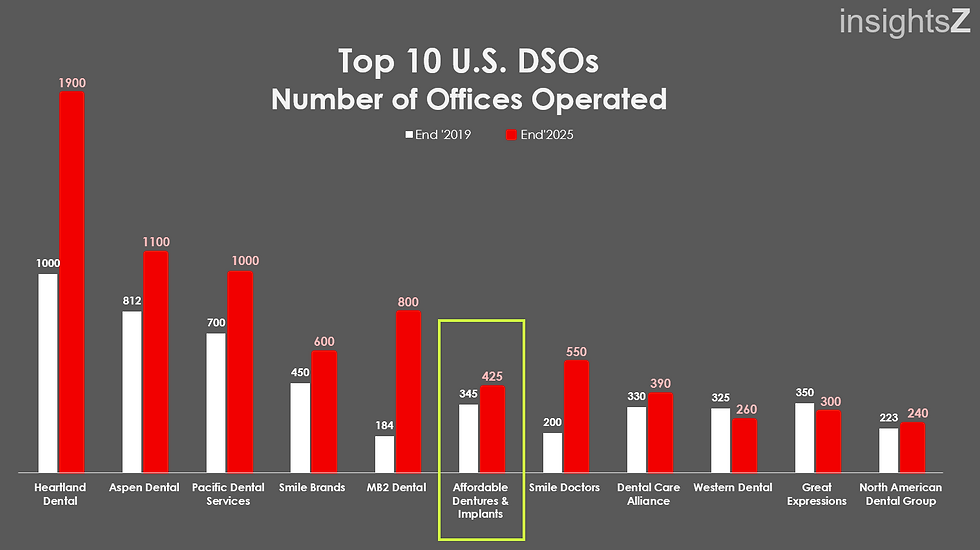
FY2024 insightsZ observed significant growth in small-scale acquisitions and De-novo clinic openings, specifically by KKR backed DSOs incl. MB2 Dental and Heartland Dental, both of which continued to be well-capitalized, and emerged as DSO growth leaders during the financial year. The country’s largest DSO Heartland Dental even emerged as the De Novo growth leader – adding +37 de novo openings LTM alone. During the same period, DSO Affordable Care reported only 12 new de-novo clinic openings.
FY2025 more than 40 DSOs were brought to market, yet fewer than 10 transactions successfully closed. Even though PE backed DSOs continued to drive consolidation, platform-level DSO deals reported slowing down. To summarize: shifts in the macroeconomic environment rippled through the dental services sector, resulting in softer demand and more restrained valuations at the higher end of the market. During this period, Affordable Care reported '0' de-novo clinic openings.


M&A Momentum has Slowed
Many PE sponsors who acquired DSOs at peak multiples (12–15x EBITDA) in FY2021 found that current market multiples had compressed. Rather than selling at a loss or a flat return, they chose to extend their hold periods beyond the typical 5-year window.
End’2025, insightsZ data showed that over 37 PE-backed DSOs were more than five years into their investment cycle—a period when they would typically have sold.
FY2025 Stubborn Interest Rates: Although rate cuts were expected, the Federal Reserve took a more cautious approach than anticipated. With rates remaining high, the cost of the debt required to fuel massive platform acquisitions remained a deterrent.
Inflation Thresholds: Inflation did not consistently dip below the 2% target, keeping operational costs high and making it difficult for buyers to forecast future profitability accurately.
The "Tariff Shock": The introduction of broad tariffs on dental equipment and supplies in mid-2025 created a mid-year dip in confidence. DSOs suddenly faced higher CapEx, which put an immediate strain on the EBITDA of practices in the middle of a sales process.


The DSO Industry Headwinds
Broader Dental Service Prices are Rising
Recent ADA survey findings and U.S. Consumer Price Index (CPI) data indicate that dental spending has increased by approximately 5% on a year-over-year basis - another trend that may be contributing to patients deferring dental treatment. The data also point to rising year-ahead inflation expectations among consumers, which could signal a more cautious approach to discretionary spending.
insightsZ expects same-office revenue growth to remain in the low single-digit range during the first half of 2026. In parallel, DSOs are expected to continue emphasizing digitization initiatives, pricing discipline, and the deployment of AI-enabled solutions to meet their top-line growth objectives.


Rising Cost Pressure
A survey conducted by the ADA’s Health Policy Institute (HPI) indicates that costs for supplies, materials, equipment, and labor have risen significantly in 2025 (outpacing inflation), with many practices experiencing increases across multiple categories, including consumables, wages, and equipment.
These cost pressures are constraining practice margins, often prompting both independent and DSO-affiliated practices to adjust treatment-fees over time.
Overall, margins have declined year-over-year, driven by tariff impacts, incremental wage investments, and further increases in dental equipment and supply costs (↑approximately 4–5%).
insightsZ estimates that staffing and labor represent 25–27% of a dental practice’s total revenue. Concurrently, staffing shortages continue to limit access to care nationwide.


3. Reimbursement Rates Declining
A growing share of dental practices are reevaluating their participation in insurance networks. According to the ADA’s Q2 2025 Economic Outlook Survey, 23% of dentists dropped some or all insurance plans in 2024, and approximately one-third are seriously considering doing so in 2025, on average across practice types, sizes, and geographies.
This shift is being driven primarily by persistently low reimbursement rates and increasing administrative complexity, which together place significant operational strain on practices. Managing insurance-related requirements has effectively become a substantial labor burden, often requiring multiple dedicated staff roles.
As reimbursement pressure intensifies and patient dissatisfaction rises, many practices are exploring alternative operating and revenue models. Moving out of network necessitates meaningful changes to workflows, patient communication strategies, and financial structures, frequently including greater reliance on fee-for-service arrangements or membership-based plans.
While not all practices are transitioning fully away from insurance participation, these dynamics are fundamentally reshaping practice operations and business models, reflecting a broader structural shift underway across the dental industry.

4. Arrival of AI in Dental office
AI is revolutionizing dental healthcare - by enabling earlier, faster, and more accurate diagnoses. Across the ecosystem, AI is demonstrating its capabilities to alleviate dentist burnout and improve treatment outcomes by automating administrative and routine tasks - allowing healthcare professionals to devote more time to direct patient care.
The early AI – based enablers including transcription software and diagnostics support, which have been plugged into the office’s existing workflows and practice management software - have emerged as key players to drive productivity. The outcome – higher workflow efficiency and a broad-based reduction in unit costs.
On the other hand, more diagnoses or overdiagnoses from AI based SaaS may act as another cost-inflator by driving up treatments and total patient spend. We have covered more on this subject in one of our recent research reports here.


Dental offices continue to invest in SaaS, but cut back on CapEx
insightsZ research found that FY2025 SaaS and AI spending continues to outpace other investments in the dental office - as the relevant decision makers continue to remain committed to their investment objectives. Beyond that, dental offices are increasingly postponing major equipment/ CapEx purchases.
insightsZ continues to monitor the sell-out metrics at leading dental suppliers and dealerships in North America and found that the ASP (average selling prices) for dental equipment and supplies rose by 5 percent approx. in FY2025 – this trend was evident in ADA’s recent surveys as well.

Levers for Value Creation
FY2025 US Dental Services Industry continued to navigate a complex landscape of patient behavioural shifts, inflationary pressures, and AI disruption. Dental Support Organizations (or DSOs) account for approx. 22~23 percent of the entire dental services industry in the country. Previous forecasts projected industry growth of approximately 5% for FY2025; however, same-clinic revenue growth has remained largely low-single digit throughout FY2024 and FY2025 – impacting top-line growth for leading DSOs, smaller dental chains and even independent dental offices.
To fight off the current trends and macroeconomic headwinds, leading DSOs are lining up promotions and payment programs to drive patient traffic. Whereas on the other hand, the economics of small & independent dental offices paints a slightly different picture - being operating at lower margins (versus group practices and DSOs). Based on an ADA survey (American Dental Association), the average cost of operating a dental practice for a solo practitioner is typically 22% higher than the cost of running a group dental practice such as one supported by a DSO.
Leading North American DSOs have implemented a wide range of strategies in recent quarters to boost same-office revenue growth in a time of high consumer price sensitivity and macro challenges. Many DSOs are even reinventing themselves with re-positioning and new patient marketing campaigns, whereas others are driving change by implementing enterprise-wide AI and digitization programs.
The KKR-Blackstone deal is expected to create synergies with other key players within the dental manufacturing and services landscape, eventually driving the next stage of growth for Affordable Care, while improving profitability metrics.
Driving same-clinic revenue growth and implementing margin optimization initiatives
KKR and Blackstone-backed DSOs’ procurement teams focus on lowering their dental consumables expenses through the negotiation of preferred pricing, which is facilitated by their online ordering and invoicing portal. Such procurement platform-based tools enable dental offices to monitor multiple catalogues of dental supplies at preferred prices, leading to cost savings at their practices and increasing group’s total purchasing volume. Not just that, the DSOs’ combined scale and preferred relationships with distributors and OEMs also enable them to get higher discounts on CapEx investments.
insightsZ found that the average consumables spend as a % of revenue for the practices acquired in FY2023 by a leading North American DSO was approx. 6.9% at the time of their acquisition, while the practice network’s average consumables spend as a % of revenue in FY2023 was only 4.5% (source: Dentalcorp Annual Report as proxy). Note: Any item with a value above $500 would be classified as an equipment.
The new relationship with KKR and Blackstone may enable Affordable Care to further drive its margin optimization initiatives and improve the overall bottom-line.

Source: insightsZ estimates; Dentalcorp. Annual Report

Overcoming Cost Volatility
Even though many upstream players incl. manufacturers and OEMs have increased ASPs in response to cost increases and inflationary macro within the last 30 months, downstream organizations incl. DSOs and dental offices have struggled. As an outcome – many DSOs and offices have left treatment services pricing unchanged or only minor increases.
Based on a recent ADA survey, dentists’ incomes have continued to decline YoY – in both absolute as well as real basis. Higher operating costs, workforce shortages, and limitations of insurance networks have been the leading drivers of higher office overhead (%) costs.
Let us consider a hypothetical scenario wherein a dental office is generating USD 1 million in production, with an estimated overhead of 75 percent (median overhead% based on latest ADA estimates). A single-digit percentage point, let’s say 1 percent reduction in overhead expense, may translate into USD 10,000 in additional higher operating income. Now let’s ballpark a more realistic percentage improvement of anywhere between 3-4 percent, which may translate into additional USD 30,000 – 40,000 operating incomes. This figure can be especially significant looking at the current macroenvironment where topline growth has shifted into lower gear.
The KKR + Blackstone deal may enable its DSOs to realize cost savings through traditional synergy levers to help address cost pressures that are prevalent across the industry, especially as dental offices now need to focus on identifying strategies to decrease costs to offset rising overhead, in addition to leveraging levers to control the existing overhead levels.
Optimizing the SCM with Just-in-time Model
insightsZ analysed the consolidated balance-sheet of a leading North American DSO and found that DSO’s inventory levels can be in the range of 3-3.5 percent of the company’s annual revenue (or for the dental office’s revenue for that matter).
insightsZ estimates that Affordable Care’s current inventory level can be north of USD 15 million. Of course, there are challenges when it comes to managing inventory of such ticket sizes, including:
Inventory levels have to be actively managed and there’s even 3-5% variance each year between the inventor in stock, and what’s being counted.
Additionally, products may become obsolete, exceed their shelf-life or clinicians may want to a different product but unable to do so.
Especially as DSOs move to focus on same-clinic revenue growth and implementing margin optimization initiatives, there is a clear need that offices have less space to store products and that revenue-generating spaces take priority.
insightsZ estimates that post SCM transformations following better integration with Henry Schein’s ordering and logistical systems, KKR backed DSOs can realistically save 3-5% annually over the mid-term horizon.

insightsZ continues to monitor the ongoing developments and plans to share its findings in the upcoming version of this report.
DISCLAIMER:
The content of this website is NOT an investment advice and does not constitute any offer or solicitation to offer or recommendation of any investment product. It is for general purposes only and does not take into account your individual needs, investment objectives and specific financial circumstances. Although the content in the website articles has been taken from sources that are believed to be accurate, no warranty or representation is made by insightsZ as to its correctness, completeness, timeliness or accuracy. insightsZ does not assume or undertake any duty to advise any person or investor, and accept no liability whatsoever for any direct, indirect or consequential loss arising from or in connection with any use or reliance of this Information or anything contained in it. insightsZ is not a registered investment, tax or legal advisor or a broker/dealer.
How does insightsZ gather market data?
insightsZ analyses data from a wide variety of resources incl. financial statements, market trends, market research surveys and industry reports.
insightsZ engages with industry experts, attends conferences, and networks with professionals in the dental industry to get firsthand insights and perspectives on market developments.
insightsZ also relies on social listening tools, share of search tools, and other search index tools. Additionally, we also monitor USFDA filings, information about product recalls, USPTO (US Patents and Trademarks Office) patent applications, EPO (European Patent Office) patent applications, CE applications, Premarket Notifications, Premarket Applications, GUDID registrations and other publicly available databases.
insightsZ does NOT use any material non-public information that could lead to legal issues such as insider trading.
Concerning market research interviews, we make sure that we follow the below mentioned guidelines and conduct expert interviews in a responsible and ethical manner:
Clearly define the purpose of the interview: Before conducting the interview, we make sure that the expert understands the purpose of the discussion and that the focus is on gathering general insights and perspectives rather than specific, confidential information.
Ask open-ended questions: insightsZ frames questions in a way that encourages the expert to share their knowledge and expertise without divulging sensitive or confidential information. We avoid asking for specific details about companies, products, or financial performance that could be considered material non-public information.
We don’t discuss specific securities or investments: insightsZ refrains from asking the expert about specific stocks, companies, or investment opportunities that could be considered material non-public information. We focus on keeping the conversation focused on industry trends, market dynamics, and general insights.
Respect confidentiality agreements: If the expert is bound by confidentiality agreements or insider trading regulations, we stay mindful of their limitations and avoid putting them in a position where they may inadvertently disclose material non-public information.
Conduct interviews in a professional manner: We maintain a professional and ethical approach throughout the interview process. We stay transparent about our intentions, respect the expert's expertise, and ensure that the conversation remains focused on general insights and industry trends.


Comments